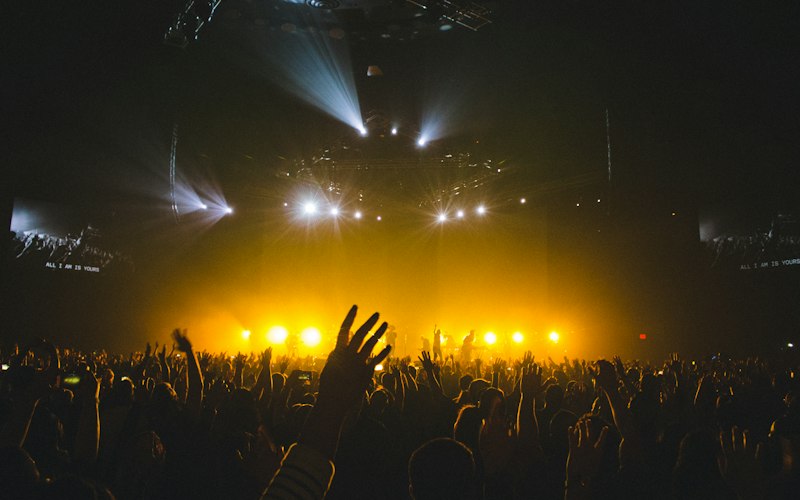
There's a number that's hard to get your head around until you've seen it in person. One million people, spread across fields and parks and city centres and beachfronts, gathered for the same reason: to be somewhere that matters, surrounded by music and strangers who are, for a few days, not strangers at all.
That's what EVENTIM LIVE delivered in the summer of 2026. Over one million total attendees across its portfolio of festivals in Germany, the UK, Austria, Switzerland, and beyond. Rock am Ring, Rock im Park, Hurricane, and a slate of events spanning genres, geographies, and formats — all operated, ticketed, and delivered under one roof.
The demand signal is clear: Rock am Ring sold 48,000 tickets for the 2027 edition in the first hour of going on sale — a record for promoters PRK DreamHaus, FKP Scorpio and Eventim Presents. More than half the 90,000 capacity gone before most people had finished their morning coffee. Blink-182 announced as the debut headliner for 2027.
The operational challenge nobody talks about
Running a single large festival is hard. Running a portfolio of them across multiple countries simultaneously is a logistics operation that has more in common with military deployment than with what most people imagine when they think about the music business.
Consider what goes into a single multi-day outdoor event: temporary infrastructure for tens of thousands of people, crowd management, access control at multiple entry points, real-time capacity monitoring across zones and stages, cashless payment systems, emergency response coordination, artist logistics, and — underpinning all of it — a ticketing platform that handled the on-sale months ago and now needs to verify every barcode at every gate without a millisecond's delay.
Now multiply that by a dozen events happening in the same two-week window, across different countries with different regulations, different languages, different payment methods, and different weather. The only thing that stays constant is the platform underneath.
Why festivals matter to the broader business
Festivals are more than a revenue line. They're the most intense operational stress test a ticketing and live entertainment company can face. The demand spikes during on-sales are among the highest in the industry — hundreds of thousands of fans competing for tickets in the first minutes. The venue operations are the most complex, with no permanent infrastructure to fall back on. And the customer experience expectations are the highest, because festival-goers plan their summers around these events.
Every lesson learned at a festival — about queue management, about mobile ticketing in areas with patchy connectivity, about real-time capacity tracking, about cashless payment in rain-soaked fields — feeds directly back into the platform. The improvements that get battle-tested at festivals end up strengthening the experience for every concert, every arena show, and every major sporting event on the network.
The scale behind the milestone
One million attendees means one million individual journeys — from the moment they registered interest, through the on-sale, through ticket delivery, through the gates, and through the weekend. Each journey generates data. Purchase preferences. Travel patterns. Spending behaviour. Engagement signals. When aggregated across a portfolio of this scale, that data becomes a strategic asset — not just for EVENTIM, but for the artists, the sponsors, and the local economies that depend on the festival circuit.
The live entertainment industry likes to talk about experiences. And rightly so — there's nothing quite like standing in a crowd of 80,000 people when the headliner walks on stage. But behind that experience is an infrastructure stack that's increasingly sophisticated, increasingly digital, and increasingly central to how the industry operates. One million fans is a good milestone. The machine that made it possible is the real story.